When buyers ask AI who to choose, Anvero shows you the answer.
We designed, built and launched an AI visibility platform, then proved it on our own infrastructure before selling it to anyone. Every number on this page was measured by Anvero on omnipath.ai between 18 October and 4 November 2026.
Each square is 1% of answers. Lighter squares are where the rate stood on 18 October. Illustrative rendering of Anvero’s measured rates.
Measured on our own site, every figure dated.
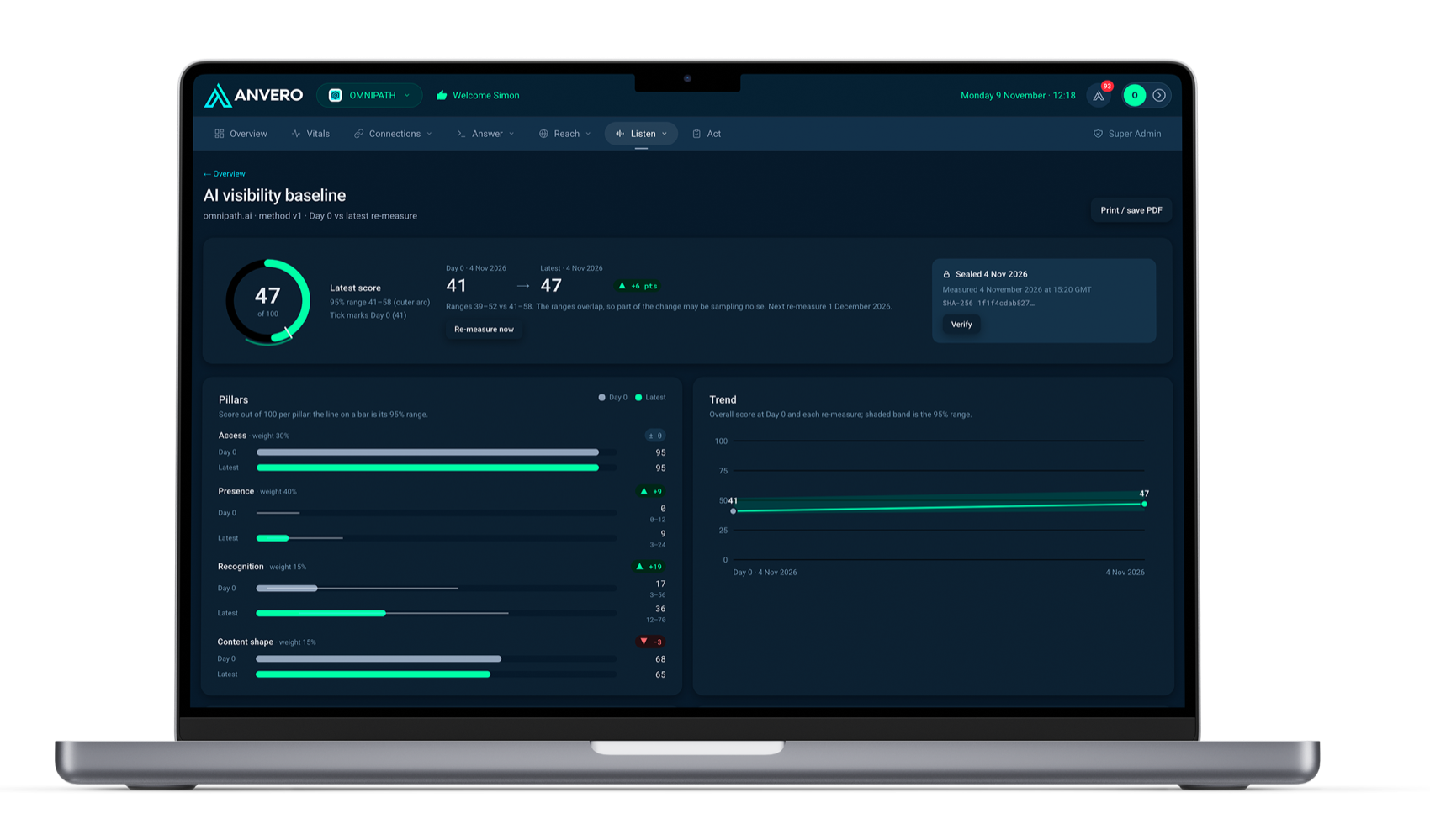
Buyers ask AI first, and most websites can’t see the answer.
Search stopped listing and started answering. A buyer who once compared ten blue links now asks ChatGPT, Claude, Gemini or Perplexity who to choose, and gets a shortlist of three. If your business isn’t on it, you never knew you were in the running.
We saw this first at OmniPATH, our AI procurement platform for multi-site operators. Three problems kept coming up.
The invisible shortlist.
We could track our Google rankings, but not whether an AI assistant named us when a buyer asked. ChatGPT and Claude answering from memory didn’t name OmniPATH at all, because their training predates the brand.
The brief is a guess.
Our content plan came from keyword tools, not from the questions real buyers were typing on our site or into AI assistants.
The website couldn’t reply.
A buyer who arrived with a question met a search box and a menu, not an answer. The tools on the market each solved one half; nobody joined the two. So we built that, and made our own site the first customer.
Our own infrastructure as the ground truth.
We refused to sell a claim we hadn’t tested on ourselves. Every feature went live on OmniPATH’s website before it went in a deck. Three surfaces did the work: omnipath.ai as the test bed, LEDGE as its visible AI agent with Anvero underneath answering from 1,530 pages and documents, and anvero.ai answering questions about itself with its own widget.
Five rules kept the testing honest
- Rates, not screenshots. A panel of buyer questions, sampled many times per engine, reported with an uncertainty range.
- Seal the starting line. The Day-0 score is fingerprinted and locked.
- A person approves every change. Nothing is published automatically.
- Every number carries its method and date.
- No outcome promises. Nobody can honestly guarantee what an assistant will say.
Start from the buyer’s question, not the keyword.
Keyword tools help you get found. Anvero answers the people who found you. Five modules, each answering one question a marketer asks.
Anything that gets asked questions can use it: shops, hotels, universities, charities, help centres. A solutions hub of 14 pages, five by team and nine by type of website.
Enter a website, get an AI readiness score out of 100 and the top three fixes, with the full report by email.
In a market full of “rank in ChatGPT” promises, we wrote the claims rules first: every illustration labelled, every number dated, no guarantees.
Platform, website and design system, in parallel.
Three things at once, each stage producing a written document the next stage built from. A Python service on Google Cloud Run in London with each client’s data walled off at the database level; a WordPress plugin that indexes pages as they publish and fixes a missing llms.txt in one click; a Next.js dashboard; infrastructure as code, protected branches, automated tests, features behind switches.
The website followed the path we use for every client: content first, prototype second, theme third, runbook last. On launch, anvero.ai scored 100 / 100 / 100 / 100 in PageSpeed Insights.
Tokens and the animated background
What the ground truth changed.
| What we tested | What we found | What we changed |
|---|---|---|
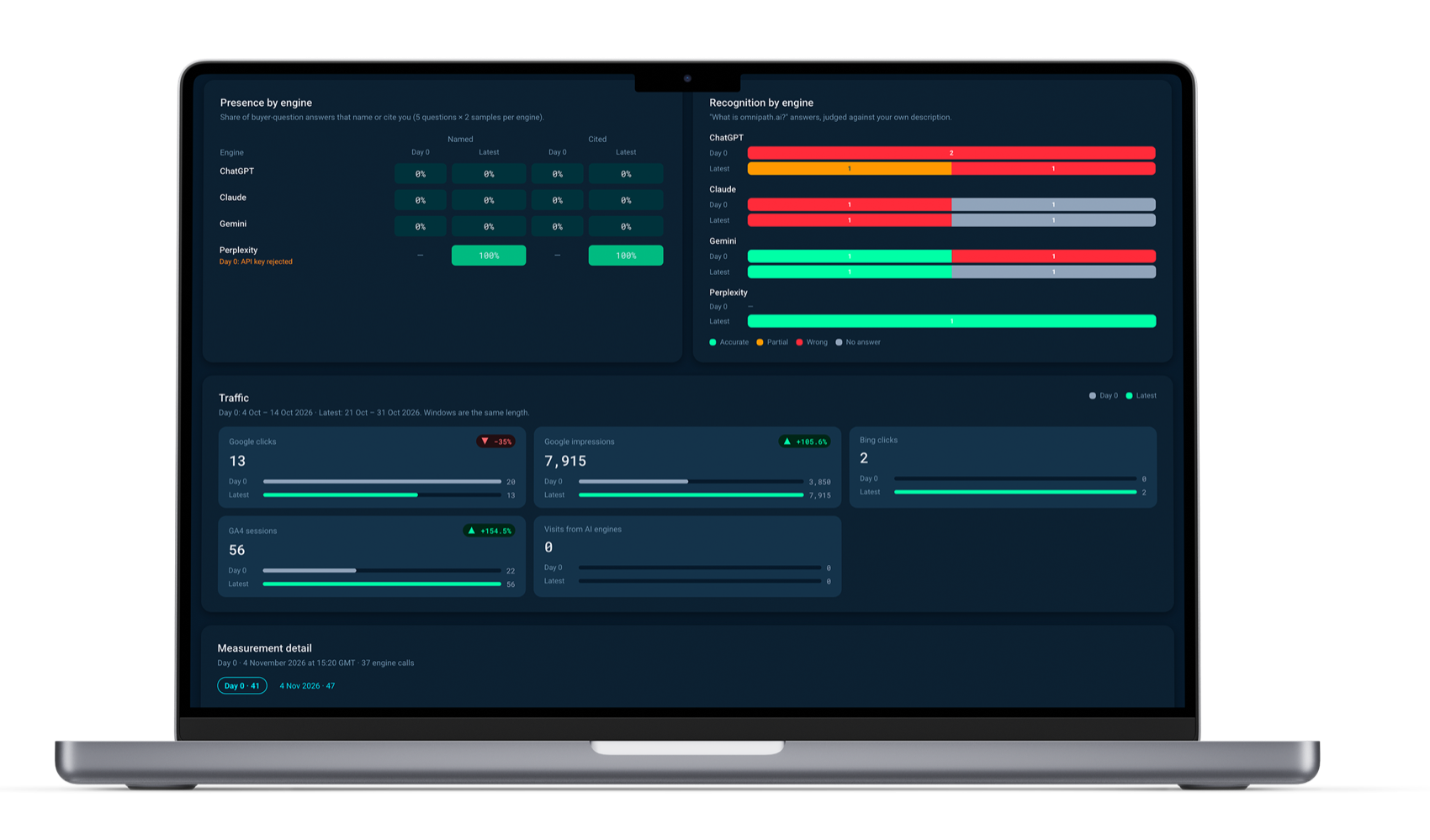
| Single ChatGPT checks | Answers varied run to run, so one result proved nothing | A panel of buyer questions sampled repeatedly per engine, reported as rates with ranges (69 ChatGPT answers by 4 Nov) |
| Perplexity results | 50% looked strong but rested on 10 samples | Excluded from every claim until the sample is large enough |
| Same-day re-run of the baseline | Scored 47, six points above the sealed 41 | Kept 41 as Day 0; change is only reported at the monthly re-measure |
| ChatGPT & Claude from memory | Neither named OmniPATH: training predates the brand | Reported as an honest gap; the fix is published content the next training runs can see |
| Crawler access | robots.txt and the CDN both let the AI crawlers in | Confirmed 100/100 across three audits |
| The to-do list | Fixed items lingered until someone ticked them | Act re-checks and closes them itself: 44 closed automatically, incl. 29 llms.txt items |
| A question a competitor was winning | No page on omnipath.ai answered it | Act drafted an article from OmniPATH’s own pages; a person reviewed it and sent it to WordPress as a draft |
| Support videos | 20 videos had no schema or transcripts AI could read | Video schema and reviewed transcripts; 176 pages now indexed |
| Meta titles & descriptions | Page-meta score sat at 38 | One approval in Meta studio took it to 93, live within 2 minutes |
The copy changed too. An early one-liner promised that Anvero “makes sure the answer is you”. Our own rules banned it, because nobody controls what an assistant says. It became the line this page opens with.
What moved, measured and dated.
In the 18 days to 4 November 2026, omnipath.ai was named and cited more often by the two engines that search the live web. All figures are Anvero’s own measurements.
Endpoints are Anvero’s reported figures; the intermediate weeks are drawn as a straight path for illustration.
The honest gap: ChatGPT and Claude answering from memory still don’t name OmniPATH, because the brand is newer than their training. That’s the next thing to move.
LEDGE answering a buyer question with sources cited. With captions and transcript.
The films that took it to market.
A silent, scroll-stopping series: one message per film, every mock-up labelled illustrative, every figure dated.
Buyers ask AI who to choose, and most businesses never see the answer.
Transcript
A buyer asks an AI assistant who to choose. Three names come back and theirs is not one of them. The message: when buyers ask AI first, most businesses never see the answer.
Your website answers buyers first, grounded in your content, sources cited.
Transcript
A visitor asks a question on a website. Anvero answers from the published pages, cites the sources and offers a next step. The message: your website answers buyers first, grounded in your content.
Can AI read your site? A score out of 100 and your top fixes, free.
Transcript
Anvero checks whether AI crawlers can read a site, comparing what robots.txt allows against what the CDN actually serves, then returns an AI readiness score out of 100 with the top fixes. The message: can AI read your site, checked two ways, free.
See what ChatGPT, Claude, Gemini and Perplexity say about you, as rates.
Transcript
Anvero puts a panel of buyer questions to ChatGPT, Claude, Gemini and Perplexity and reports how often each one names and cites you, as rates rather than screenshots, against the competitor average. The message: see what AI says about you.
See, fix, prove and answer: one platform across all four.
Transcript
The four jobs Anvero does, as one platform: see what AI says, fix what it cannot read, prove what moved and answer buyers on your own site. The message: see, fix, prove and answer.
AI visibility rewards the things good websites always needed.
A site can welcome crawlers in robots.txt while its CDN blocks them. The cheapest fix and the one most often missed.
AI answers vary run to run. Without repeated sampling and a sealed starting point, you can’t tell progress from noise.
Original data no keyword tool has, and the gaps in your answers are your content plan.
Engines that search the web pick up a change within weeks. Engines answering from training only catch up when retrained, so start publishing now.
AI can draft from your own pages in seconds; a named reviewer keeps it accurate, and it is what Google’s guidance now asks for.
Testing on our own infrastructure turned a promising product into one we can stand behind, number by number.
Good questions about AI visibility.
What is AI visibility?
How often AI assistants such as ChatGPT, Claude, Gemini and Perplexity name, cite and recommend your business when people ask them questions. It depends on whether AI crawlers can read your site, whether your content answers the questions buyers ask and whether the engines recognise your brand correctly.
How do you measure whether ChatGPT recommends a business?
Anvero puts a panel of real buyer questions to each engine repeatedly, from memory and with live web search, and reports how often the business is named and cited, its average position and who is recommended instead. Results are rates with uncertainty ranges, because single answers vary run to run.
What is a sealed Day-0 baseline?
The AI visibility score measured on day one, then fingerprinted and locked so it can’t be edited later. Every monthly re-measure is compared against it, so improvements are provable and can’t be rewritten after the fact.
Did Anvero cause the rise in Google impressions on omnipath.ai?
We don’t claim it did. Impressions rose from about 1,900 to 5,700 a week in the four weeks after the omnipath.ai relaunch, which also brought a new site and new content. We report it as context, not as an Anvero result.
How is this different from SEO tools such as Semrush, Rank Math or Yoast?
SEO tools start from keyword data about the whole market and help you get found. Anvero starts from your own visitors’ questions, measures what AI engines say about you and answers buyers on your own site. Most teams use both.
Does Anvero only work on WordPress?
No. WordPress sites get a plugin that indexes as you publish and applies fixes in one click. Any other website, including Shopify, adds Anvero with one script tag.
Can Digital Creative do this for our website?
Yes. We run the free AI audit, plan the fixes and build what’s needed: content, a WordPress or Shopify build, or a full AI visibility programme. We’re based in Henley-on-Thames and work with brands across London and the South East.
Start with the free AI audit.
Enter your website and get an AI readiness score out of 100 with your top three fixes. Then talk to us about turning the findings into a plan, the content and the build.
Written by Simon Haynes, founder of Digital Creative and OmniPATH AI. Figures measured by Anvero on omnipath.ai, 18 October to 4 November 2026, and refreshed on the day this page is published.